
How to Write a Top-Notch Job Description with AI Assistance


In the competitive world of software development, the distance between finding a diamond-in-the-rough candidate and settling for a mediocre hire often begins with a single document: the Job Description (JD). While it is tempting to view a JD as a mere administrative hurdle, its quality is directly linked to the caliber of candidates you attract.
A well‑crafted JD markets the role, filters unqualified applicants, and lays a foundation for smooth interviews. When written well, a JD acts as both a marketing asset and a filtering mechanism.
Today, AI can accelerate the drafting process. However, speed alone does not guarantee quality. The most effective teams combine AI-assisted drafting with human judgment to produce clear, accurate, and compelling job descriptions. This article outlines how to do exactly that.
Table Of Contents
The High Cost of a Poor Job Description
The recruitment process operates on a simple principle: garbage in, garbage out. If your job description is vague, uninspired, or inaccurate, you are likely to attract candidates who do not meet your actual needs, leading to wasted time in interviews and potential turnover. Investing time and effort upfront to create a thoughtful, accurate JD is not just a best practice, it is a strategic necessity to attract the best talent in the industry.
There is also a direct cost implication. A poor hire can cost up to two times the employee’s salary when you account for onboarding, lost productivity, and rehiring. A well-written JD reduces this risk by setting accurate expectations early.
Equally important, a strong JD builds trust. Candidates evaluate your organization based on how clearly you communicate responsibilities, technologies, and goals. A precise, thoughtful description signals that your team is organized and intentional.
Get the Skills Right: Precision Over Generalities
One of the most common pitfalls in hiring, particularly for technical roles like developers, is being too vague about skills. To find the ideal fit, you must go deeper into your specific tech stack. Phrases like “experience with modern frameworks” or “strong front-end skills” leave too much room for interpretation. Candidates cannot accurately assess their fit, and recruiters struggle to screen effectively.
- List Tangible Hard Skills: Instead of generic terms, list specific languages, frameworks, libraries, and technologies (e.g., Python, React, Tailwind, n8n, AWS, etc.). This helps candidates quickly determine relevance.
- Define Proficiency Levels: A top-notch JD differentiates between “must-have” qualifications, “strongly preferred” skills, and “nice-to-have” extras. This creates a clear evaluation framework for both candidates and interviewers.
- Communicate Reality: Clear skill requirements help candidates understand exactly what they will be working on, reducing friction later in the hiring process. Describe how each technology is used within the project. For example, “Build scalable APIs using Node.js and integrate with third-party services.”
Providing this level of detail improves alignment across the hiring process. Candidates arrive better prepared, and interview conversations become more productive.
Don’t Let the AI Write Everything: The Human-in-the-Loop Advantage
AI is a powerful ally in the drafting process, but it should never be the sole author of your job description. While AI excels at generating initial ideas and providing a first draft, human involvement is irreplaceable for ensuring correctness and cultural alignment.
The most effective human-in-the-loop workflow (and the one I use personally) involves:
1. Generate a draft with AI. Provide context such as the job title, purpose of the role and key responsibilities. Use the output as a starting point.
2. Refine with domain expertise. A hiring manager or technical lead reviews the content for accuracy, removes generic language, and adds project-specific details.
3. Align tone and expectations. Ensure the JD reflects your company culture, communication style, and realistic scope of the role.
This approach balances efficiency and quality. AI handles structure and speed, while humans ensure correctness and relevance.
Teams that rely solely on AI often produce generic descriptions. Teams that combine AI with expert review create JDs that are both efficient to produce and highly effective.
Spotlight: The Scalable Path Job Description Tool
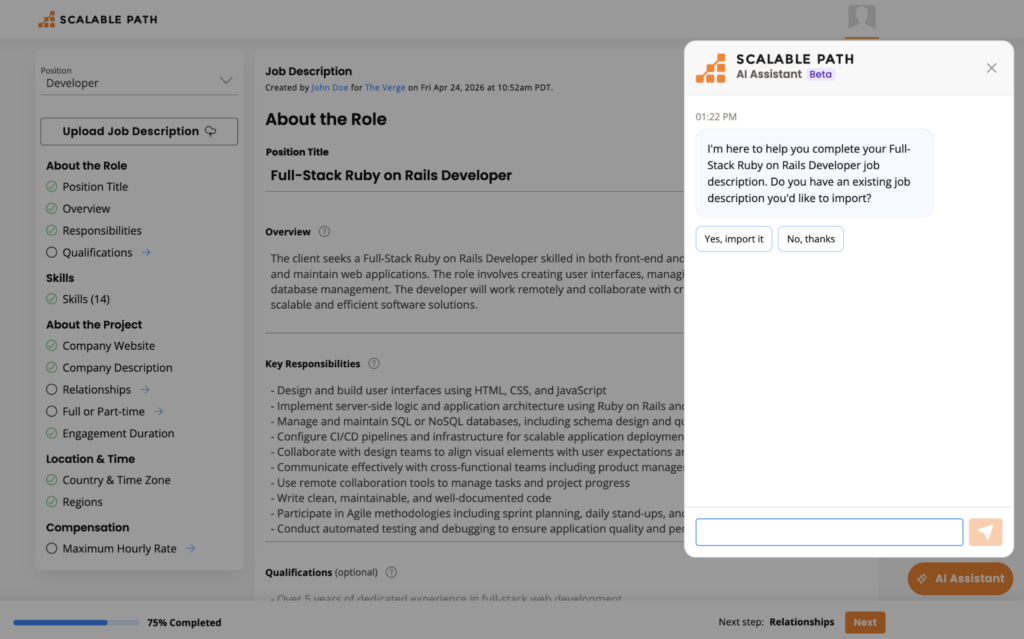
To streamline this process, the Scalable Path Job Description Tool has been developed to guide clients through a high-quality workflow. This tool integrates recruitment best practices into an intuitive, AI-powered platform. If users don’t want to fill in each field manually, they can interact with an AI agent that asks targeted questions about responsibilities, technologies, and project goals.
Key capabilities include:
- Smart Data Import: Users can import existing job descriptions from a URL or an uploaded file (.pdf, .docx, or .txt) to save time.
- Interactive AI Agent: Instead of just filling out the static form, you can chat with an AI agent that asks targeted questions to elicit critical information for the JD.
- Structured Workflow: The tool walks you through essential modules—from title and responsibilities to a detailed skills matrix and project logistics—ensuring no vital detail is missed.
Conclusion: Better JDs Lead to Better Hires
Ultimately, a job description is more than a list of requirements; it is a marketing tool and a filter for quality. By being specific about technical needs, maintaining human oversight of AI-generated content, and using guided tools, you can ensure your hiring process starts on a solid foundation. Remember: the effort you put into the description today determines the quality of the team you build tomorrow.