
The Hidden Cost of a “Near-Miss” Hire: Why Technical Skills are Only 50% of the Equation


For a Seed or Series B founder, hiring isn’t just about “filling a seat.” It’s a high-stakes bet on your company’s survival.
In a market where a single Senior Engineer in the U.S. can cost $180,000+, every addition to your engineering team either accelerates your trajectory or acts as a silent anchor slowing you down.
We often talk about “bad hires”, the ones who clearly can’t code. Those are easy to spot and quick to fire. The real danger to your startup isn’t the “bad” hire; it’s the “near-miss.”
The near-miss is the developer who is technically “fine” but doesn’t click. They ship code, but it’s brittle. They attend stand-ups, but they don’t collaborate. They are the silent assassins of startup momentum. According to research from Harvard Business Review, a staggering 80% of employee turnover can be traced back to these poor initial hiring decisions.
Table Of Contents
- The Invisible Tax of a Near-Miss Hire
- The Vetting Crisis: Architecture-Led vs. Algorithm-Led
- Chemistry Match: The Ultimate ROI Multiplier
- How Founders Keep Hiring “Great Interviewers” Who Underperform
- Vet Fast, Hire Right
- How to Evaluate Candidates in an AI-Assisted World
- The Cost of the "Safe" Choice
- What a Better Hiring Bar Looks Like
- Conclusion: Build a Team That Clicks
- Founder FAQ: Surviving the 2026 Technical Hiring Market
The Invisible Tax of a Near-Miss Hire
When a hire fails, the salary you paid them is just the tip of the iceberg. The U.S. Department of Labor (2025) estimates that the average cost of a bad hire is at least 30% of the employee’s first-year earnings. For specialized technical roles, the impact is significantly more severe.
A study by SHRM indicates that the total cost of a bad hire in a senior technical role can reach up to $240,000 once you factor in recruitment, compensation, and the “vacancy tax.”
The Breakdown of the “Silent Killer”
| Cost Category | 2026 Estimated Impact | Why it Kills Your Startup |
| The “Redo” Factor | 17-20% of Leadership Capacity | Senior devs spend nearly a full day per week refactoring “brittle” code from a near-miss. |
| Lost Momentum | 3-5x Total Compensation | The opportunity cost of delayed features and “un-shipped” revenue during a 6-month ramp-up. |
| Cultural Friction | 30% Productivity Drop | Gallup reports that actively disengaged or mismatched hires drain the energy of high-performers. |
| Retention Chain Reaction | 82% Risk Increase | A “near-miss” in a leadership or senior role often triggers attrition among your best existing talent. |
Why Near-Misses Are More Common in the AI Hiring Era
The market has changed. The hiring process often has not.
Candidates now have better tools for polishing resumes, tailoring outreach, and preparing for interviews. That does not make them dishonest by default. It does mean founders need stronger signal. A polished profile tells you less than it used to.
At the same time, many hiring funnels still rely on filters that were already weak before AI entered the picture. Resume screens are easy to game. Take-home assignments can be heavily assisted. Puzzle-based coding tests reward preparation patterns that often have little to do with production engineering.
This creates a dangerous false positive. You meet someone who looks great on paper, sounds sharp in an interview, and passes a generic coding screen. Then they join your team and struggle with the actual job: making trade-offs, working through ambiguity, and communicating clearly when requirements shift.
That gap between interview performance and day-to-day execution is where startups get hurt.
The Redo Factor: The Cost You Feel First
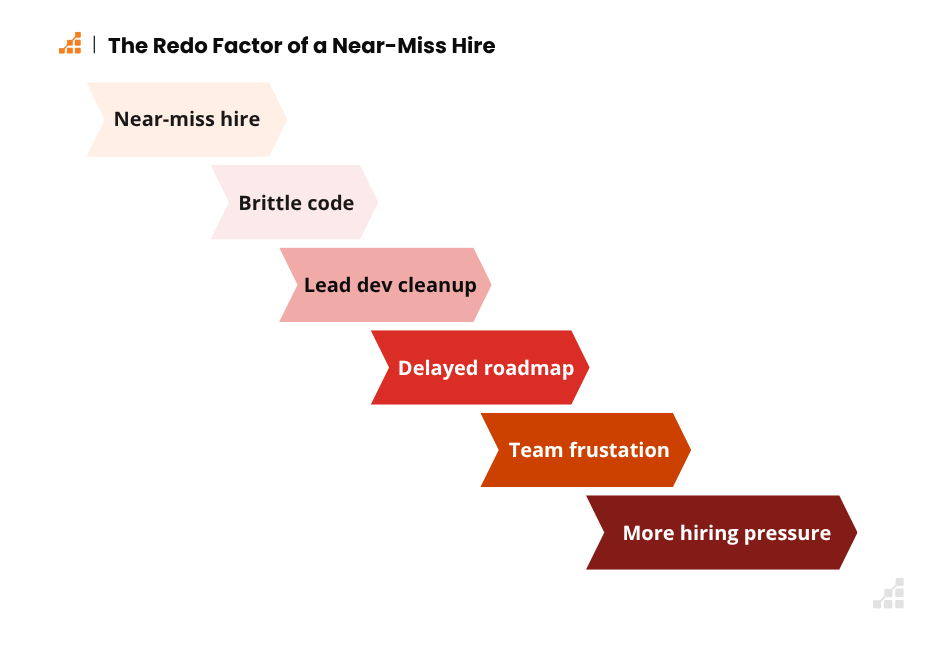
The first visible sign of a near miss is usually not a missed deadline. It is rework.
A startup can tolerate learning curves. It cannot afford recurring cleanup from someone hired to reduce complexity. When a supposedly senior engineer produces code that lacks context, resilience, or maintainability, your lead engineer becomes a safety net.
That is expensive in ways most spreadsheets miss.
Every hour your CTO or lead developer spends rewriting a feature is an hour they are not spending on architecture, roadmap planning, team coaching, or customer-facing priorities. The cost is not just technical. It is strategic.
This is why founders often feel the pain of a near miss before they can fully explain it. The sprint still moves. Tickets still close. But the company starts to feel slower, noisier, and more fragile.
A clean hire creates compounding value. A near miss creates compounding friction.
The Vetting Crisis: Architecture-Led vs. Algorithm-Led
Most platforms use Algorithm-Led vetting. They send a candidate a link to a standardized coding test—automated puzzles that measure if a candidate can “reverse a binary tree” or solve a math riddle in 20 minutes.
The Problem: Startups don’t build binary trees. They build products.
A 2025 Developer Skills Report found that 77% of developers believe traditional algorithmic assessments do not reflect their actual job skills. This creates a “False Positive” where a candidate is great at taking tests but lacks the judgment to build a scalable system.
Scalable Path’s Architecture-Led Approach
At Scalable Path, we move beyond the puzzle to Architecture-Led vetting. We treat the interview as a collaborative design session, not a math test.
- The Old Way (Algorithm-Led): Can they solve a LeetCode “Hard” problem? (Focuses on syntax and memorization).
- The Scalable Path Way (Architecture-Led): Can they explain why they chose a specific database schema? Do they understand the trade-offs between REST and GraphQL for your specific use case? Can they defend their architectural decisions to a peer?
Our candidates are vetted by Senior Architects, people who have built and scaled systems themselves. We look for “Defensive Programming”, the ability to write code that anticipates failure and scales with the business. According to Glassdoor, organizations that move toward this type of specialized, structured matching see an 82% improvement in new hire retention.
Chemistry Match: The Ultimate ROI Multiplier
You can have the most brilliant engineer in the world, but if they don’t understand your vision or your team’s communication style, their value drops to near zero. LinkedIn’s Global Talent Trends report reveals that 92% of hiring managers now say “soft skills” (communication, adaptability, and ownership) are as important, or more important, than hard technical skills.
We define the “Chemistry Match” as the alignment of three core pillars:
- Communication Proactivity: In a remote-first world, “good enough” English isn’t enough. You need engineers who proactively flag blockers and document their “why.”
- Ownership Mentality: Do they treat the codebase like it’s theirs, or do they just “clear tickets”?
- Time-Zone Synergy: Real-time collaboration is the heartbeat of a startup. This is the LATAM Advantage. Overlapping 8 hours a day with your team eliminates the 12-to-24-hour “communication lag” that plagues offshore teams in Asia or Eastern Europe.
The Data: Companies that prioritize this “Chemistry Match” and high-context collaboration see a 20-25% increase in total team productivity (Deloitte). Highly engaged, well-matched teams are 21% more profitable (Gallup) because they spend less time in “meeting hell” and more time in “deep work.”
How Founders Keep Hiring “Great Interviewers” Who Underperform
This is one of the most common founder complaints, and it deserves direct attention.
Some candidates interview like future CTOs. They speak confidently, use the right vocabulary, and tell polished stories about scale, systems, and leadership. Then they join and perform like a mid-level engineer who was hired into a senior seat.
This happens because many interviews reward confidence, recall, and presentation more than reasoning.
A better process forces candidates to reveal how they think. Ask them to critique a real architecture. Ask them to refactor flawed code. Ask them to explain what they would optimize first and what they would leave alone. Ask follow-up questions until you get past prepared answers.
The goal is not to make the interview harder. It is to make it more representative.
A strong candidate should be able to explain trade-offs, challenge assumptions, and communicate uncertainty clearly. Seniority shows up in judgment long before it shows up in clever code.
Vet Fast, Hire Right
Founders often hear “hire slow, fire fast” as blanket advice. The spirit is understandable, but the phrase can be misleading.
If “hire slow” means a careful process with strong signal, that is healthy. If it means weeks of resume review, generic screenings, and internal indecision, it becomes a runway problem.
The real goal is to vet fast and hire right.
That means reducing noise early and concentrating your time on a small number of high-signal conversations. It also means deciding what you actually need before you open the role. Are you hiring for architecture? speed of execution? team stability? stakeholder communication? Many hiring mistakes begin before the first interview because the role itself is underdefined.
A sharper process does not need more steps. It needs better ones.
How to Evaluate Candidates in an AI-Assisted World
By now, founders should assume candidates may use AI during parts of the hiring process. That is not always a deal-breaker. Engineers use AI on the job too.
The question is not whether AI was involved. The question is whether the candidate still demonstrates sound judgment.
That is why static take-home tests are becoming less reliable as a primary filter. A better approach is live, collaborative evaluation. Ask candidates to walk through a design. Give them flawed code and ask how they would improve it. Explore a business scenario with incomplete requirements and see how they respond.
AI can help generate code. It is much less reliable at revealing intent, priorities, and contextual decision-making.
That is where human signal still lives.
The Cost of the “Safe” Choice
Founders often feel “pressured to fill the seat,” leading to what CareerBuilder calls “Panic Hiring” (38% of all bad hires). But in the 2026 economy, where AI is rapidly automating the “syntax” of coding, the human elements of architecture and chemistry are your only remaining competitive advantages.
As Joe Kraus, founder of Excite, famously said: “The cost of hiring someone bad is so much greater than missing out on someone good.”
A near-miss hire doesn’t just cost you money; it costs you Time-to-Market. And for a startup, time is the only resource you can’t buy more of.
What a Better Hiring Bar Looks Like
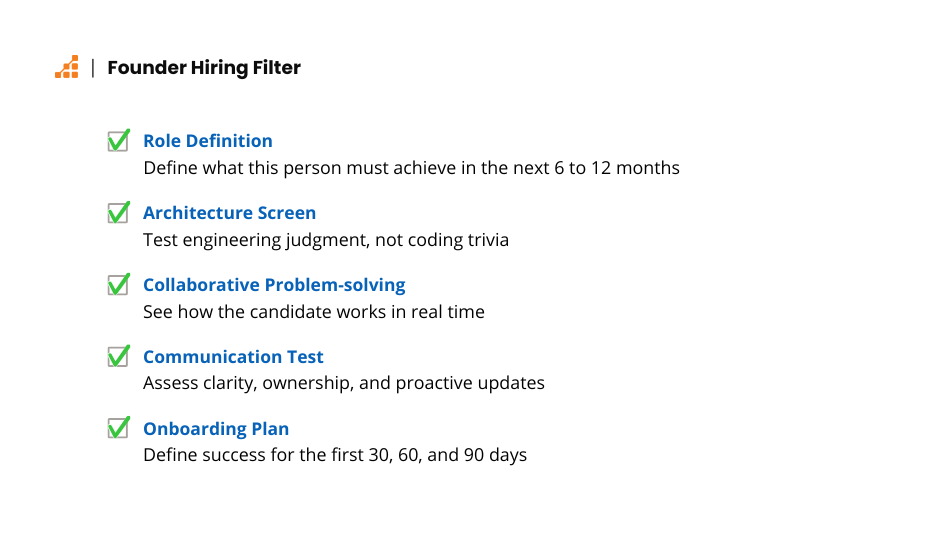
For founders building remote engineering teams, a stronger process usually includes a few simple changes:
- Evaluate real-world engineering judgment, not just puzzle performance
- Test communication in the same environment where the person will actually work
- Look for ownership signals, not just output signals
- Define success for the role before starting the search
- Treat onboarding as part of hiring, not something that starts later
That last point matters more than many teams realize. Research commonly attributed to Brandon Hall Group and Glassdoor has found that strong onboarding is associated with 82% better new-hire retention and more than 70% higher productivity. Even the right hire underperforms if the handoff into the team is weak.
Great hiring is not just candidate selection. It is selection plus a setup that allows the person to succeed quickly.
Conclusion: Build a Team That Clicks
The most expensive hiring mistake is rarely the obvious one.
It is the near miss. The engineer who looks capable, sounds credible, and never quite becomes a force multiplier. They do enough to stay in the role, but not enough to move the company forward with confidence.
For early-stage teams, that kind of hire is dangerous because the damage is subtle. It shows up as rework, slower decisions, weaker collaboration, and delayed product momentum. Over time, that drag becomes expensive.
Technical skills still matter. They are just not enough.
The better hiring question is not, “Can this person code?” It is, “Will this person strengthen how our team builds, communicates, and scales?”
That is where the real ROI lives.
At Scalable Path, we don’t just provide “talent.” We provide the architecture and the chemistry that allows your startup to scale without the “Near-Miss Tax.”
Founder FAQ: Surviving the 2026 Technical Hiring Market
How do I stop hiring people who interview like CTOs but code like juniors?
Move away from interviews that reward confidence and memorization. Use architecture-led discussions, collaborative debugging, and scenario-based trade-off questions. Strong candidates should be able to explain why they made a decision, not just what they did.
Is “hire slow, fire fast” hurting my startup?
It can. If your process is slow because it is thoughtful and high-signal, that is fine. If it is slow because you are manually sorting weak applicants and running generic screens, it is a drain. The goal is to reduce noise fast and spend time only on the candidates who can actually do the job.
How can I tell if a candidate is using AI in technical assessments?
Assume some candidates are. Instead of trying to police every tool, design interviews around explanation, judgment, and collaboration. Ask candidates to talk through trade-offs, refactor bad code, or reason through ambiguous requirements in real time.
What does the redo factor really cost?
Usually more than founders expect. The direct cost is the salary you paid the wrong hire. The bigger cost is the time your strongest people spend correcting, coaching, and compensating for that hire instead of moving the product forward.