
The Power of the Daily Commit


In the world of software development, consistency isn’t just a habit, it’s a competitive advantage. At its simplest level, a “daily commit” is the act of pushing code to a shared repository at least once every workday. But look closer, and you’ll find it is a fundamental pillar of professional reliability, risk management, and team momentum.
Whether you are a developer looking to sharpen your craft or a client seeking transparency in a remote engagement, understanding the power of the daily commit is essential.
“The secret of getting ahead is getting started. The secret of getting started is breaking your complex overwhelming tasks into small manageable tasks, and then starting on the first one.”
Table Of Contents
The Philosophy of Small, Consistent Gains
The principle of the daily commit extends far beyond the IDE. It is the same logic that governs physical fitness: you don’t get in shape by spending ten hours in the gym once a month; you get there by showing up for 30 minutes every day.
In development, a daily commit is your “reps.” It forces you to break large, intimidating features into smaller, shippable units. This habit creates a feedback loop of micro-successes that maintains psychological momentum and ensures that progress isn’t just a “feeling”, it’s a documented fact.
Why Clients Appreciate Daily Commits
For a client, particularly in a remote-first environment, visibility is the currency of trust. When a developer doesn’t push code for several days, a “black box” is created, leading to uncertainty and project risk.
Daily commits help solve this problem in several ways:
- Visibility and Proof of Work: Daily commits provide quantifiable evidence of productivity. It allows stakeholders to see the project evolving in real-time, rather than waiting for a massive “reveal” that might miss the mark.
- Data Security and Disaster Recovery: Code that exists only on a local machine is a liability. Hardware failures, lost laptops, or accidental deletions can wipe out days of expensive work. Pushing code daily acts as an off-site backup.
While metrics like lines of code are imperfect, they still offer directional insight. They help answer a simple question: is work moving forward?
Ultimately, daily commits build trust by making progress visible and verifiable.
The Developer’s Advantage: Why You Should Want This
Many developers view frequent commits as an administrative burden. In reality, it is a safety net for your own professional reputation and technical efficiency.
Risk Mitigation
Daily commits create a safety net. If you break your local environment or realize you’ve gone down a rabbit hole, having a “known good” state from yesterday to revert to is a lifesaver.
Asynchronous Communication
Your commit history tells a story. It allows teammates to see what you’re working on without needing to interrupt you with a Slack message.
Avoiding “Integration Hell”
Small, daily updates are significantly easier to merge than massive, week-long code dumps. It helps identify bugs and merge conflicts early, when they are still easy to fix.
This practice also reinforces discipline. It encourages developers to close loops, finish small tasks, and maintain clean working states.
In practice, daily commits make your work easier to manage and your contributions easier to understand.
The Metrics Trap: Quality vs. Quantity
It is important to acknowledge the limitations of Git metrics.
We’ve all seen the flaws in using “Lines of Code” (LOC) as a benchmark. A developer might spend hours researching and then write 20 lines of perfectly optimized code. This is often more valuable than 500 lines of AI-generated boilerplate.
Other factors can also distort metrics:
- Using third-party libraries can inflate contributions.
- Refactoring may reduce code while improving quality.
- Planning and architecture work often produce no immediate commits.
At Scalable Path, we treat metrics as a diagnostic tool, not a final verdict. A total lack of commits is a red flag that warrants a conversation, but the goal is never to reward “noise.”
The goal is not to reward activity. It is to ensure meaningful progress.
Best Practices for Professional Commits
A daily commit is only as good as the information it carries. Professionalism in your git history is a sign of a great programmer.
- Atomic Commits: Keep each commit focused on a single logical change. This makes it easier to review and debug.
- Meaningful Messages: Avoid “fixed stuff” or “update.” Use the imperative mood (e.g., “Add user authentication logic”) to explain what the commit does. For a deeper guide, see: https://cbea.ms/git-commit/
- End-of-Day Ritual: Make committing part of your daily routine. Before signing off, ensure your work is pushed and documented.
These small habits create a clean and professional project history that benefits everyone on the team.
The Agency Perspective: Balancing Trust and Insight
From an agency standpoint, daily commits serve both operational and relational purposes.
They help build trust with clients by providing transparency. At the same time, they offer early signals when something may be off track.
However, this approach must be handled carefully.
Benefits
- Builds client confidence through visibility
- Helps identify productivity issues early
- Provides objective data during performance discussions
Risks
- Developers may feel pressured or micromanaged
- Metrics can be misunderstood or overemphasized
- Lower commit frequency may be misinterpreted as low productivity
The key is balance. Metrics should inform conversations, not replace them.
When used correctly, they strengthen relationships rather than strain them.
The Scalable Path Git Metrics Tool
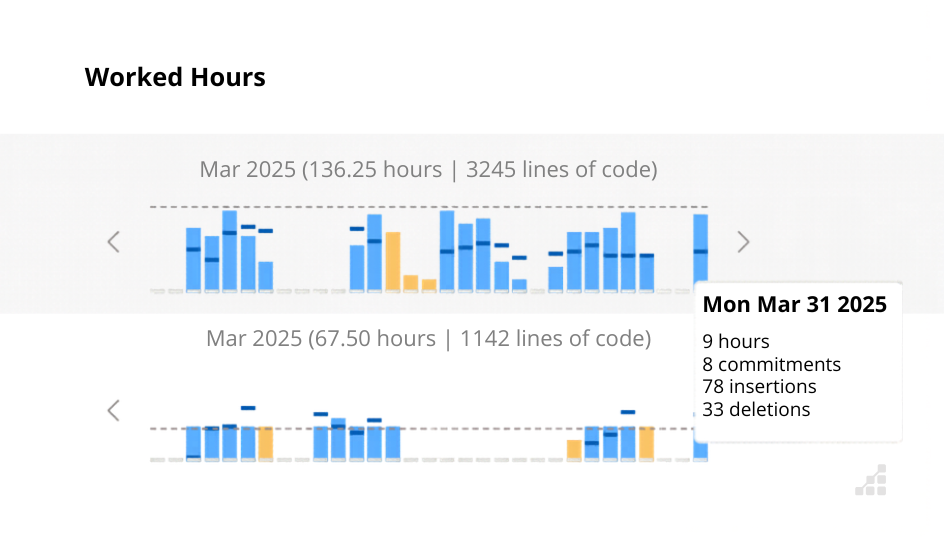
The importance of this practice led us to develop our own internal tool for tracking git activity across projects. The idea wasn’t born from a desire to track hours, but from a need to solve a specific client problem.
One of our clients was concerned about a particular developer’s productivity. By manually auditing the developer’s Git history, we were able to identify that the developer was indeed being productive. This manual process was slow, so we automated it.
Today, this tool integrates with our time tracking and reporting systems. It allows us to:
- Cross-reference billed hours with repository activity
- Provide clients with transparent progress indicators
- Quickly identify anomalies or gaps in activity
Clients can enable this feature as needed. It acts as a “sanity check” that protects both the client’s investment and the developer’s reputation.
The goal is not surveillance. It is clarity.
Final Thoughts
The daily commit is more than a technical requirement; it is a communication strategy.
It builds trust through transparency and ensures that teams stay aligned, even when they are thousands of miles apart. By embracing the habit of small, consistent progress, you reduce risk, increase efficiency, and build a more resilient development process.
Key Takeaways
- Trust through Transparency: Daily commits eliminate the “black box” of development for clients.
- Developer Safety: Frequent pushes act as a backup and a way to simplify complex merges.
- Quality over Volume: Metrics should be used to identify silence, not to reward meaningless “code bloat.”
- Professionalism: Clear commit messages and atomic updates are the hallmarks of a top-tier developer.