
The Technical Leader Most Companies Forget to Hire


A company does everything the advice says to do.
It hires offshore developers at a third of US rates. It buys the AI coding tools everyone is writing about. It moves onto a modern cloud stack and stops paying for servers it doesn’t use. On paper, engineering costs should be falling.
Twelve months later, the burn rate is the same or worse. The roadmap has barely moved. Nobody can point to a single bad decision, because there wasn’t one. Every purchase was defensible.
What went wrong is harder to see, because it isn’t a purchase at all. Nobody was running the work.
Not “leading” it in the strategic sense — someone was almost certainly doing that. Running it. Deciding what gets built this week and in what order. Turning a rough idea into something a developer can start on without guessing. Noticing on Tuesday that someone has been stuck since Friday. Reading the code that came back and catching the problem while it’s still cheap to fix.
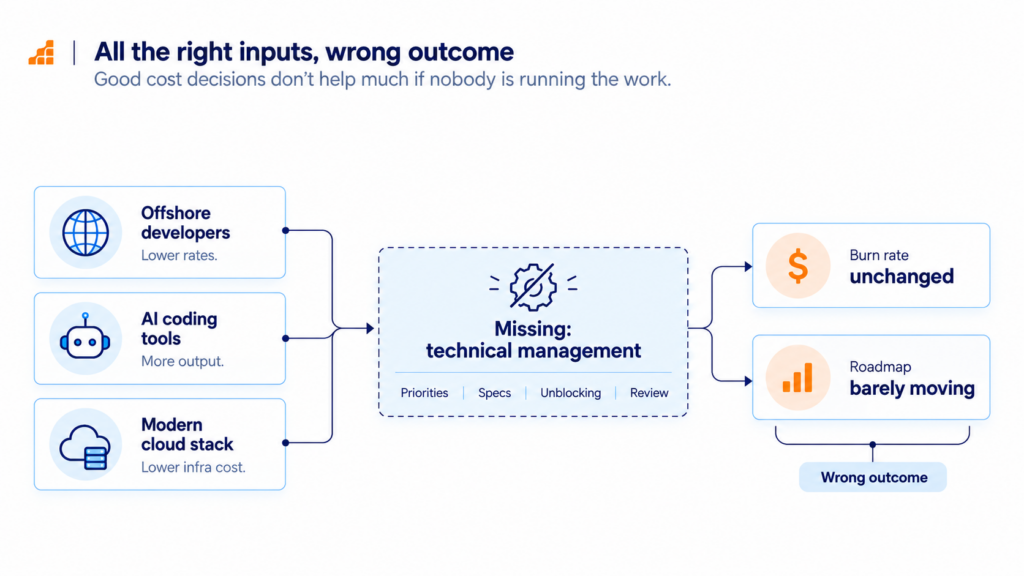
That job has a name, but it doesn’t have a title most companies think to hire for. And when it goes unassigned, cheap developers and good tools don’t lower your costs. They just lower your hourly rate while the total keeps climbing.
Table Of Contents
- Two technical leaders, two different jobs
- Why the same person rarely does both
- Why the manager role goes unfilled
- What it actually costs
- What a good technical manager actually does
- "Isn't that just a project manager?"
- Why this gap got more expensive in 2026
- Where this hits hardest: contract and offshore developers
- What to do about it
- The bottom line
Two technical leaders, two different jobs
Most companies think of technical leadership as one role with one job description. It isn’t. There are two, and they answer different questions.
The visionary answers what should we build, and how should it be put together?
This is the person who decides the architecture, picks the stack, and judges whether an approach will still hold up in three years. They can sit across from an enterprise customer or an investor and explain the technical strategy in a way that lands. Their work is mostly thinking, deciding, and persuading — and you measure it in months and years. Was that the right bet?
The manager answers is this actually getting built, how fast, and what is it costing?
This is the person who takes the vision and converts it into specific work: this task, this person, this week, done by Thursday. They know who is blocked right now, without having to ask. They read what came back and catch the problem before it’s buried under three more weeks of work built on top of it. You measure this in days and weeks. Did it ship, did it work, did it cost what it should have?
Picture the two weeks side by side.
The visionary’s week: an architecture decision, an afternoon evaluating a new tool, a call about the security model with a prospect, and a long uninterrupted think about whether the data model will survive the next product line.
The manager’s week: a hundred small interactions. Rewriting a vague request into something buildable. Noticing a task has been “almost done” for four days and finding out why. Reviewing a pull request. Deciding what gets bumped when the sprint slips. Answering the question that has been blocking someone since yesterday afternoon.
One job is a small number of large decisions. The other is a large number of small ones. That’s the real difference — not seniority, not technical depth, not who is smarter. Decision size and decision frequency.
| The Visionary (architect) | The Manager (runs the work) | |
| Answers | What should we build, and how should it be put together? | Is this getting built, how fast, and what’s it costing? |
| Works in | Months and years | Days and weeks |
| Typical day | A few big decisions | A hundred small ones |
| Needs | Long uninterrupted stretches | To be reachable all day |
| Handles ambiguity by | Sitting in it — that’s where the work happens | Removing it before it reaches a developer |
| A free afternoon goes to | Redesigning something | Unblocking three people, clearing the review queue |
| Judged on | Was that the right bet? | Did it ship, did it work, did it cost what it should have? |
| Who usually fills it | Hired deliberately, with a title | Absorbed part-time by someone already full |
Why the same person rarely does both
It would be convenient if one great hire covered both jobs. Occasionally one does. Usually the traits that make someone good at one actively work against the other.
The visionary needs long stretches of uninterrupted thought — that’s the raw material of the work. The manager’s job is the interruptions; being reachable is most of the value they provide. Ask a visionary to be interrupted forty times a day and you’ve destroyed the conditions their work requires. Ask a manager to disappear for a week of deep thinking and three people go idle.
The visionary is comfortable sitting in ambiguity, because that’s where their contribution happens. The manager’s entire job is to eliminate ambiguity before it reaches a developer, because ambiguity is what turns a three-day task into a three-week one.
They’re also drawn to different work. Hand each of them a free afternoon and watch what happens. The visionary redesigns something. The manager unblocks three people and clears the review queue. Both are genuinely useful. Only one of them ships this week’s feature.
Some people really do both well. They are rare, they are expensive, and at any real scale they usually can’t do both at the same time. They end up picking one and letting the other slide — and in our experience, the one that slides is almost always the management.
Why the manager role goes unfilled
Three forces push in the same direction, and they compound.
The title problem. “CTO” and “VP of Engineering” are the roles a founder or a board knows to hire for. Both tend to get filled with vision-oriented people, because that’s what the title implies and what the interview process selects for. Nobody sits in a board meeting and says the thing we’re missing is someone to run the sprint. It doesn’t sound like a leadership gap. It sounds like an administrative one.
The status problem. Engineering management gets quietly treated as the lesser job — what you do when you’re not quite good enough to be the architect. So strong candidates don’t want the role, and companies don’t think to pay well for it. Meanwhile, it is the single job with the most direct control over what everything costs.
The absorption problem. The most common outcome isn’t that the job sits empty. It’s that it gets absorbed part-time by someone who is already full. A founder squeezes it in between fundraising and sales calls. A senior developer takes it on top of a full coding load. Both do it badly — not from incompetence, but because the job requires being available all day, and neither of them is.
The failure that follows is rarely dramatic. It shows up as friction:
- Developers wait a day or more for answers to small questions
- Priorities shift mid-sprint, and work already underway gets abandoned
- Something gets built from a vague description, then rebuilt when it turns out to be wrong
- Nobody can say what a finished feature actually cost
- Status updates come from asking people how it’s going, not from anything anyone is tracking
- The team stays visibly busy and the roadmap doesn’t move
Each one looks like a minor annoyance. Together, they are the entire cost problem.
What it actually costs
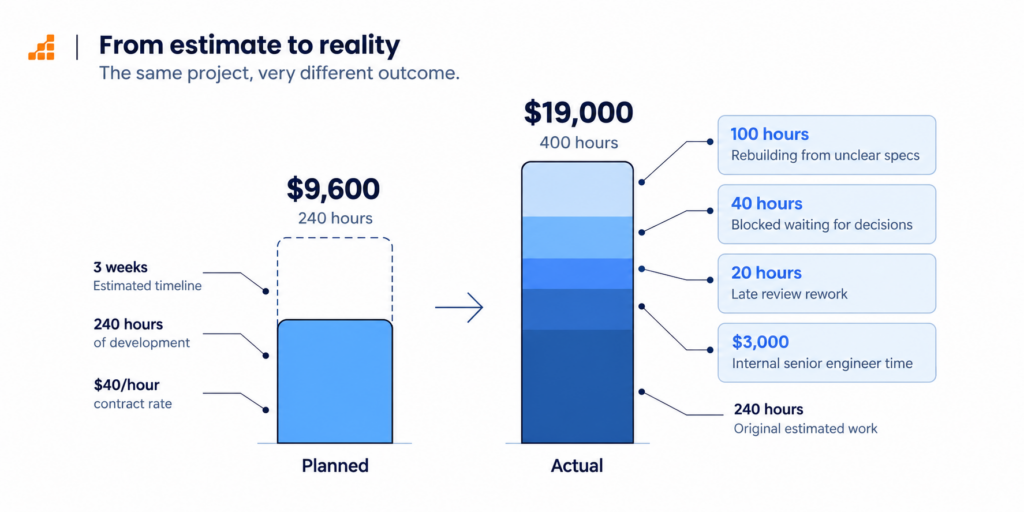
Here’s a composite example. The numbers are illustrative, but the shape of it is common enough that it may look familiar.
A company sets out to build a customer-facing reporting dashboard. Two contract developers at $40 an hour, estimated at three weeks. The expected cost is straightforward: 240 hours at $40 comes to $9,600.
It took five weeks. Here’s where the money went.
Billed hours: 400 instead of 240 — $16,000. The extra 160 hours break down roughly as: about 100 hours rebuilding the reporting logic after the original spec turned out to describe the wrong thing (discovered in week three); about 40 hours of developers blocked and waiting on decisions; and about 20 hours of rework from code review feedback that arrived a week after the code did.
In-house senior engineer time: about $3,000. Roughly five hours a week for five weeks, answering questions, clarifying requirements, and untangling the rebuild. At a loaded cost of around $120 an hour, that’s $3,000 that never appeared on any invoice or in any engineering budget.
Actual total: roughly $19,000 against a planned $9,600. Plus two weeks of delay, which meant the sales team couldn’t demo the dashboard in a quarter where it would have mattered.
Now look at what didn’t go wrong. The developers weren’t slow. They weren’t unqualified. The rate was good. Nobody was lazy or dishonest.
What happened is that the spec was vague, answers came slowly, and review came late. Every one of those is a management failure, not a talent failure. The company didn’t overpay for developers. It paid twice for the same feature.
And here’s the part that stings: a competent technical manager working ten hours a week across those five weeks would have cost around $2,000, and would almost certainly have caught the spec problem in week one — which is the difference between $19,000 and something close to the original estimate.
What a good technical manager actually does
“Get better technical leadership” is useless advice unless you can say what the person does on a Tuesday. Concretely:
They turn vague requests into specifications a developer can act on without guessing, which is the single highest-leverage thing anyone does in a software organization, because guessing is where rework comes from.
They sequence the work so people aren’t waiting on each other. They review what comes back early, while fixing it is still cheap. They know what things actually cost, including the invisible parts: waiting time, rework, tools nobody is tracking. And they watch quality alongside speed, so the team doesn’t simply get faster at producing work that has to be redone.
“Isn’t that just a project manager?”
It’s the first thing people say when we describe this role, and it’s a fair question. A lot of that list does look like project management: sequencing work, tracking progress, keeping people unblocked.
A good project manager will get you part of the way. They’ll keep the schedule honest, chase down dependencies, run the standup, etc. That’s real work and it’s worth paying for.
But the decisions that actually move the cost of a feature are technical judgment calls, and they can’t be made from the outside.
A project manager can tell you a task is three days late. A technical manager can tell you it’s three days late because the API was designed wrong, and that patching it now will cost you a month next quarter.
The distinction shows up constantly in small moments. Is this spec buildable as written, or does it quietly contain two weeks of work nobody scoped? When a developer says something is almost done, is that true, or are they stuck on a problem they’d rather solve than admit to? Is this pull request fine, or is it a shortcut that works today and gets expensive in six months? Should this be rebuilt or patched?
None of those questions can be answered by someone tracking status. They require someone who can read the code, or at least ask the second and third question well enough to find the truth.
This isn’t an argument against project managers. Plenty of teams run well with a strong PM handling coordination and a senior engineer providing the technical judgment. That works. What doesn’t work is assuming a PM alone closes the gap — you end up with excellent visibility into a project that is going wrong for reasons nobody in the room can diagnose.
Why this gap got more expensive in 2026
The management gap has always been costly. Two things have made it harder to hide.
AI coding tools raised the stakes on review. Code volume goes up dramatically; quality varies. The old proxies (commits, pull requests, lines of code) now tell you close to nothing, because they measure output that a tool can inflate on demand. Someone has to be reading what comes back with real judgment. Without that, AI tooling doesn’t make your team faster at shipping. It makes them faster at generating rework.
Distributed and contract teams need more deliberate direction, not less. There are no hallway conversations, no ambient sense of who is stuck, no overhearing that two people are solving the same problem. If direction isn’t explicit and scheduled, it doesn’t happen at all. Every bit of coordination that used to be free now has to be someone’s job.
Where this hits hardest: contract and offshore developers
The rate math on offshore hiring is real and worth taking seriously. A senior engineer in a major US city can run $150,000 to $250,000 before benefits and overhead. Contract rates in Latin America, Eastern Europe, and South Asia are a fraction of that, for genuinely excellent people.
But there are three ways to buy that talent, and the meaningful difference between them isn’t price. It’s who does the managing.
Freelance marketplaces give you the lowest sticker price. You do all the vetting, you do all the managing, and you absorb the full cost of every bad hire yourself.
Staff augmentation (which is what we do at Scalable Path) means a partner handles sourcing, screening, and contracting, and you direct the work yourself. The developer joins your team and you manage them like anyone else on it. You’re paying for the sourcing and vetting infrastructure, not a delivery margin, which is why the rates land close to direct.
Full-service agencies carry the highest price because the partner owns delivery and management. You’re buying the manager along with the developers, and giving up day-to-day control in exchange.
It’s worth being straight about our own model here. Staff augmentation gives you the best rates because you’re keeping the management in-house. Most companies are fine on this front. It’s usually a senior engineer or a hands-on founder wearing the hat alongside their other work, and for a small team, that’s often enough.
But if nobody on your side is doing that job at all, more developers won’t fix what’s slow. It’ll just cost more to stay slow. That’s true whether you hire through us, through a marketplace, or directly, the only model that solves it for you is the agency, and you pay for that in the rate and give up a fair amount of control besides.
So the honest sequence is: figure out who’s running the work first, then go shopping for developers. It’s a better outcome for you, and frankly it’s a better outcome for us.
What to do about it
First, find out which leader you have. Here’s a quick test: does someone at your company know, without having to ask around, what every developer is working on this week and what’s blocking each of them? If the answer requires a round of Slack messages to assemble, that job is currently unassigned.
If it is, you have three ways to fill it.
Promote a senior developer. Cheap and fast, and sometimes exactly right. The costs are real, though: you lose a developer, and management is a different skill from writing code. Some of your best engineers will be bad at it, and finding out takes months.
Hire a full-time engineering manager. The right answer above a certain team size. Below that size it’s genuinely hard to justify the salary, which is why so many companies keep deferring it.
Bring in fractional leadership. Buy the capability without the full-time cost. Someone who runs your engineering week at ten or twenty hours instead of forty.
The case for the fractional option is the same cost logic this whole article is about, turned on leadership itself. Most mid-sized companies need this expertise more than they need it forty hours a week. Paying for the hours you actually use is the same reasoning that made contract developers attractive in the first place. (This is a service we offer, and if it’s useful to you we’d be glad to talk, but the diagnosis holds regardless of who you hire.)
One warning, whichever route you take: be specific about which of the two roles you’re buying. A great many fractional CTOs are visionaries and genuinely excellent ones, who will help you make architecture decisions and think about your technical strategy. If your actual gap is management, a strategy advisor will not close it. You’ll get good advice, a clear roadmap, and the same friction you had before.
Ask candidates what their Tuesday looks like. The answer will tell you which job they’re built for.
The bottom line
Cheap developers and good tools are inputs. Somebody has to convert inputs into shipped software, and that conversion is a real job that requires a real person doing it all day.
Companies with strong technical management get compounding returns from contract talent and AI tooling. Companies without it get expensive chaos at a lower hourly rate — and, because the failure is slow and undramatic, they often spend two or three more expensive hires trying to solve it by looking for a better visionary.
So the question worth asking isn’t how do we spend less on engineering?
It’s who is actually running this and are they the right kind of leader for what we need?