
Beyond Vibe-Coding: A Practical Guide to Spec-Driven Development

AI has transformed how fast teams can build software, but not how easily they can build the right software. Too often, speed comes through what’s now called vibe-coding: describing an idea in tweet-sized sentences, letting the AI write the code, and fixing things as they break. It feels fast until the system starts to wobble under its own shortcuts.
The gap between “done” and “done right” keeps widening. For leaders, that means missed timelines, creeping scope, and growing maintenance pain.
Spec-Driven Development, or SDD, is the pause that saves you later. It’s taking a moment to define what success actually means before anyone starts coding. Instead of handing an AI a vague prompt and hoping for the best, you give it a clear specification that aligns humans and agents from the start.
This isn’t just a new workflow. It’s a safeguard. Left unguided, AI will vibe-code, producing code that looks fine but misses the point. A solid spec changes that, turning AI from a fast but careless assistant into a partner that truly understands the intent behind the work.
Table Of Contents
- What Is Spec-Driven Development?
- The Rise of “Vibe-Coding” with AI and Its Limits
- Why Spec-Driven Development Is Gaining Momentum with AI
- When to Use Spec-Driven Development and When Not to
- A Typical Spec-First Workflow
- SDD Tools
- Key Takeaways on Spec-Driven Development in the AI Era
- Final Thoughts on Spec-Driven Development
What Is Spec-Driven Development?
At its core, Spec-Driven Development (SDD) is exactly what it sounds like: you start with a specification, not code. Before a single line is written, you lay out what the system or feature should do in detail, including requirements, user flows, behaviors, edge cases, and constraints. That document becomes the north star. Everything else (design, implementation, testing, documentation) lines up behind it.
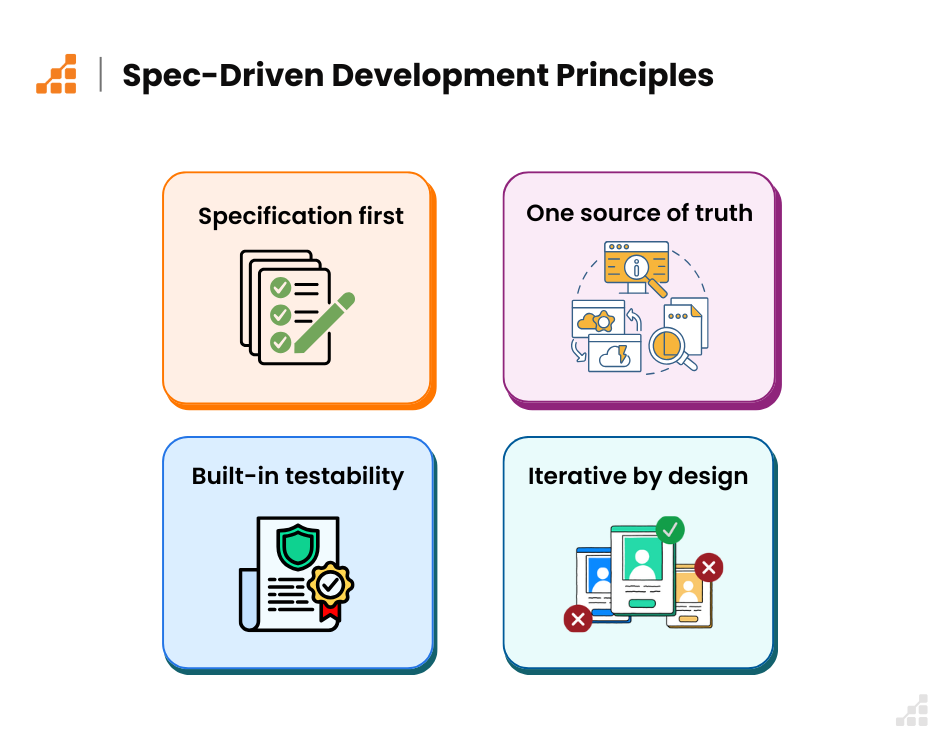
A few principles define the practice:
- Specification first. You don’t leave the requirements to chance. Expected behaviors, edge cases, and constraints are captured up front.
- One source of truth. The spec anchors the entire project. Tests, documentation, even design decisions all trace back to it.
- Iterative by design. Specs aren’t stone tablets. They evolve as teams gather feedback (from design reviews, research, or stakeholder input), but always with traceability.
The big idea is simple: don’t code until you know what you’re building, why it matters, who it’s for, and the constraints you’re working within. That discipline cuts down on ambiguity, reduces rework, and keeps teams aligned.
In short, SDD favors clarity over guesswork and creates a durable artifact that drives design, delivery, and quality.
Why It Matters Today
AI coding agents are powerful. They can generate scaffolding, components, and even entire features in minutes. But speed without structure usually produces code that only looks right. Underneath it can be brittle, misaligned, or inefficient.
Spec-Driven Development (SDD) is a way to prevent this. By defining requirements, constraints, and edge cases up front, it anchors both humans and AI. Instead of hoping the agent guesses correctly, you give it a clear target. That’s how you turn rapid code generation into reliable, maintainable software.
SDD also improves communication across roles. Product, security, and QA can validate intent before code exists, which reduces “build, reject, redo” cycles.
For teams used to traditional product docs, Spec-Driven Development feels familiar, it simply extends the same logic. A strong Product Requirements Document (PRD) defines what the product should achieve and why it matters. The spec then picks up where the PRD leaves off, translating that intent into behavior, architecture, and tests.
If you’re new to PRDs, How to Write a Great Product Requirements Document (PRD) by Scalable Path is a solid place to start.
The Rise of AI Agents
AI has changed the pace of development. Work that once took days can be done in hours. The catch: without a clear specification, much of that output needs rework. A feature that technically runs but ignores performance, architecture, or product constraints just creates future debt.
Yes, writing solid specs takes some time up front thinking and writing, but it gives direction. It reduces wasted cycles by telling the agent what “done” really means. Non-functional requirements (security, style, performance) can’t be assumed; they have to be baked in. With SDD, they are.
And when multiple agents or developers are building in parallel, specs become the coordination layer. Everyone refers back to the same source of truth, avoiding drift, conflicting choices, or duplicated effort.
The Risks of Vague Prompts
The easiest way to undermine AI is with a vague prompt. Lacking details, the system fills in gaps with assumptions. The results may work at first blush, but they often break under real-world pressure, scaling, error handling, and edge cases.
Another risk: lost intent. When requirements only exist in chat history, there’s no traceability. Future maintainers won’t know why decisions were made or what constraints mattered. Specs capture that intent and keep it accessible.
Finally, vague prompts create the illusion of speed. You get code quickly, but then spend time fixing inefficiencies, slow queries, missing caching, and unnecessary overhead. With specs, more of the work is right the first time, so momentum compounds instead of stalling in rework.
The Rise of “Vibe-Coding” with AI and Its Limits
“Vibe-coding” is the quick-and-dirty way many people use AI today. You describe what you want in natural language, see what the AI gives you, tweak, refactor, iterate. It’s fast, it’s fun, and for proofs of concept or side projects, it’s often good enough.
But the cracks show quickly once the project gets serious:
- Mounting technical debt. Shortcuts (skipping tests, mixing concerns) seem harmless at first but add fragility as the codebase grows.
- Weak coverage of edge cases and constraints. Vibe-coding focuses on the “happy path.” Performance, security, and integrations lag behind.
- Harder debugging and testing. Since code evolves from back-and-forth prompts rather than a plan, it’s harder to understand, test, or extend.
The result is a growing market for “vibe-coding cleanup specialists”, engineers brought in to stabilize messy, AI-driven projects once they reach production. As reported recently, some freelancers and companies now advertise themselves explicitly for this role, cleaning up brittle systems that were rushed out with little planning. In parallel, many startups find they eventually need a fractional CTO or senior technical leader to re-establish standards and set a sustainable direction.
Vibe-coding is fine for experiments, but brittle for production. Without structure, it produces software that feels quick in the moment but drags later in rework, or in costly “rescue” hires when things fall apart.
Why Detailed Prompts Still Aren’t Specs (and why context matters)
Some argue that writing better prompts gets you most of the way to a spec. But prompts, no matter how detailed, don’t replace true Spec-Driven Development. Here’s why:
- Prompts are temporary, specs are durable. Prompts live in chat logs; specs live in version control. A spec shows decisions, trade-offs, and constraints in a way teams can revisit.
- Constraints get lost. You can ask the AI to follow rules, but it may ignore or misapply them. A spec forces explicit treatment of performance, architecture, or compliance requirements.
- Prompts lack granularity. They often cover user-facing behavior but skip internals, dependencies, data models, and failure modes. Specs demand that level of detail.
- Limited alignment. Prompts create a loop between developer and AI. Specs act as communication artifacts for product, QA, security, and design, keeping everyone aligned.
- Weaker traceability. Specs tie requirements to tests and outputs. With prompts, it’s rarely clear which part of the request maps to which behavior.
Detailed prompts make AI output better, but they don’t provide the structure or accountability that specs deliver. Context (architecture, constraints, and standards) must be explicit, versioned, and testable. True Spec-Driven Development closes that gap.
Why Spec-Driven Development Is Gaining Momentum with AI
As AI tools move from novelty to everyday practice, Spec-Driven Development is shifting from niche best practice to near-essential. Teams are realizing that without clear specs, AI’s speed is wasted on misaligned or hard-to-scale output. With them, it becomes a true accelerator.
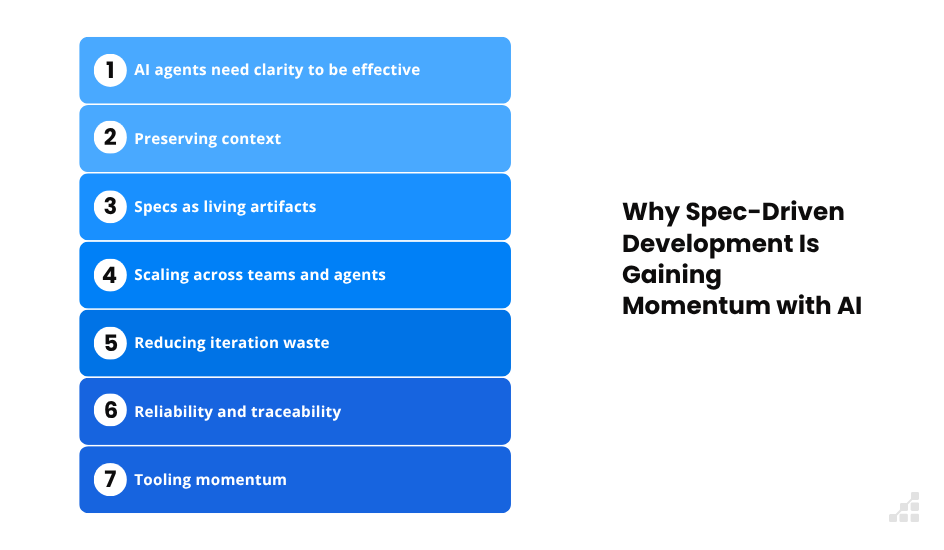
1. AI agents need clarity to be effective
AI excels at pattern recognition and boilerplate but doesn’t understand your unstated rules—performance targets, style conventions, compliance requirements. A spec gives it those guardrails. Without them, you get code that works but doesn’t quite fit.
2. Preserving context
When working with AI, context is everything: repo structure, legacy boundaries, design choices, security policies. Left unspecified, agents make “reasonable guesses” that often drift from reality. Specs capture this context explicitly—versioned, reviewable, enforceable—so it isn’t lost in chat history.
3. Specs as living artifacts
Modern tools like GitHub’s Spec Kit treat specs not as static docs but as central, evolving assets. They drive testing, task breakdowns, and validation. Because AI can consume and regenerate from them, specs make it easier to adjust course without expensive rewrites.
4. Scaling across teams and agents
On projects with many contributors—or multiple agents running in parallel—coordination problems multiply. Specs act as the shared frame of reference, keeping architecture, performance, and design consistent. Tools like Kiro are emerging specifically to support this “spec-first” workflow.
5. Reducing iteration waste
Ambiguity carries hidden costs: debugging, rewrites, rework. A strong spec front-loads the thinking, which saves cycles later. Many developers now call spec-driven AI development the “golden workflow” because it balances context, correctness, and clarity.
6. Reliability and traceability
Production systems need evidence of intent: what was planned, how it was built, and how changes will affect behavior. Specs provide that trail. Updating a spec updates plans, tasks, and tests, reducing drift and easing compliance.
7. Tooling momentum
AI-native toolchains are maturing fast. Open source kits, IDE integrations, and workflows designed around “spec → plan → tasks → implementation” are gaining traction. As more teams adopt them, standards are emerging and momentum compounds.
When to Use Spec-Driven Development and When Not to
Spec-Driven Development is powerful, but not always necessary. Knowing when to invest in full specs, and when to go lighter, helps you get the benefits without slowing yourself down.
Spec-Driven Development proves most valuable when clarity, alignment, and long-term maintainability matter. It provides a structured way to capture decisions before implementation, reducing ambiguity and preventing rework. While not every initiative requires a full-blown spec, the following scenarios are where SDD typically delivers the biggest payoff:
New Projects / Greenfield Work
Starting from scratch is the perfect time to lay foundations. A spec lets you define architecture, stack, style, and edge cases before the first commit. The payoff: features grow consistently instead of drifting into chaos.
Small to Medium Projects (even if not complex)
Even relatively simple projects benefit from upfront clarity. A lightweight spec can lock down scope, dependencies, and design choices early, preventing small misunderstandings from snowballing. The effort is modest, but the alignment it creates pays off. In my experience, in this kind of project, if you have a clear specification, you might just be the code reviewer and may not need to do much actual coding.
Complex Features or Cross-Cutting Work
Anything that touches multiple parts of the system, or involves several teams, benefits from a spec. Performance, security, and integration risks make alignment critical, and the cost of a spec is usually small compared to the cost of rewrites or bugs.
Legacy or Large Codebases
Big systems come with hidden conventions and fragile dependencies. Specs surface those assumptions, forcing them to be explicit. That clarity reduces regressions and makes large-scale changes safer.
Long-Term Maintenance
If the code will live for years, be extended, or change hands, specs act as durable documentation. They capture not just what was built, but why, context future devs (or AI agents) will need.
Production Use of AI Agents
When AI-generated code is shipping to users, especially in critical systems with performance or security requirements, specs are essential. They reduce the risk of misaligned or brittle outputs.
While Spec-Driven Development provides clarity and alignment in many contexts, there are also situations where the cost of writing a spec outweighs the benefits. In these cases, the overhead can slow progress rather than accelerate it. Here are the scenarios where a lighter approach is often better:
Small Bug Fixes / Trivial Tweaks
Changing a function name, fixing a typo, or tweaking a margin doesn’t need a spec. The overhead is higher than the risk.
Rapid Experiments and Prototypes
When you’re exploring ideas or building throwaways, precision isn’t the goal. Lightweight prompts and quick iteration are usually enough.
UI-Heavy or Design-Centric Work
If the main output is visual (animations, layouts, transitions), mockups or prototypes often communicate better than written specs. In these cases, pair a lightweight spec with design artifacts instead.
Shifting Priorities / Tight Deadlines
In unstable projects where requirements will likely pivot, investing in a detailed spec may not pay off. A hybrid approach, capturing only the most critical constraints, usually works better.
A Typical Spec-First Workflow
Spec-Driven Development follows a clear, repeatable rhythm that keeps projects aligned from idea to implementation. No rigid steps, but a steady loop that keeps everyone, from idea shapers to implementers, moving in sync. Teams can customize it, but most trace the same outline: define, plan, build, refine.
- Plan – With the spec in hand, map the route. Decide which tools, frameworks, or APIs will carry the weight, how pieces will talk to each other, and where the risks might live. This plan keeps both humans and AI systems aligned, heading toward the same north star.
- Break Down & Build – The plan becomes motion. Tasks get split, features scoped, and tickets written. Because everyone’s anchored to the same specification, choices stay consistent, even when different people (or agents) make them.
- Test & Maintain – Every change loops back to the spec. Testing checks what was promised, not just what compiles. When updates roll in, the spec evolves first, keeping documentation, design, and delivery marching in step.
Modern platforms like Kiro, GitHub Spec Kit, and Claude Code’s Spec Workflow automate chunks of this cycle, turning static specs into living blueprints that drive planning, coding, and testing in real time.
But the core idea doesn’t change: a solid specification isn’t paperwork. It’s propulsion, the engine that keeps speed, quality, and alignment working as one.
SDD Tools
Spec-Driven Development works best when it’s more than just a philosophy, when the tools you use actively support the workflow. Writing a solid specification can be demanding, and no tool will replace the need for careful thinking and review. At the end of the day, it’s still your job to make sure the spec reflects what you really want to build.
That said, the right tools can make the process easier. They help capture requirements, keep specs close to the codebase, and guide AI agents to operate within the right boundaries. Here are three that stand out today.
Kiro
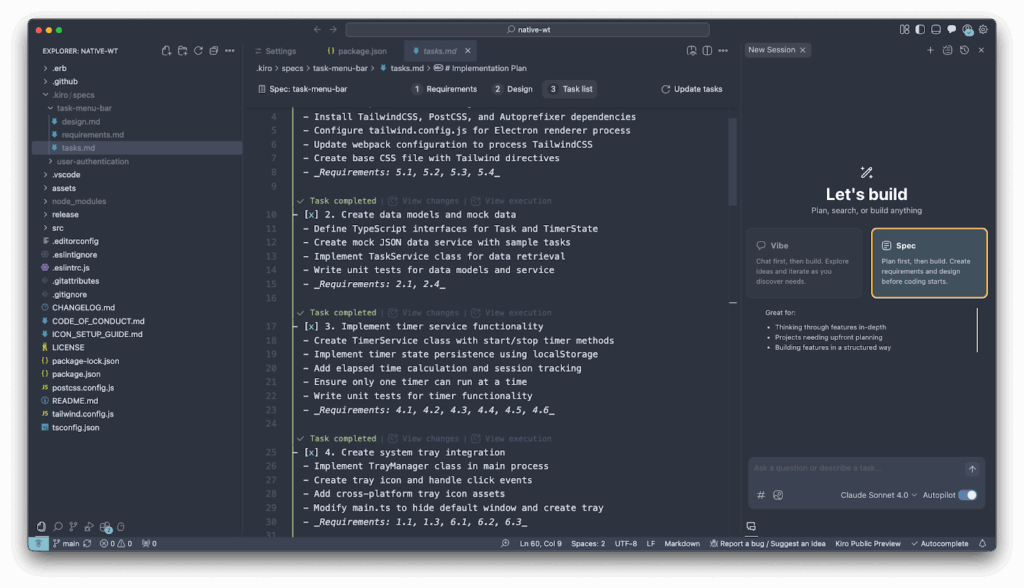
Kiro is an agent-enabled IDE designed around spec-driven development from the start. Instead of dropping prompts into an editor and hoping for the best, you use Kiro to generate requirements, system designs, and structured tasks directly from your project goals.
It supports agent hooks (triggering AI on save, commit, or other events) to automatically create tests, update documentation, and maintain consistency. With project memory, you can embed constraints like architecture choices or style conventions that the AI respects across sessions.
This makes Kiro well suited for teams that want agents actively participating in the development loop without losing structure. Kiro helps teams automate the “busywork” while keeping specs in control.
GitHub Spec Kit
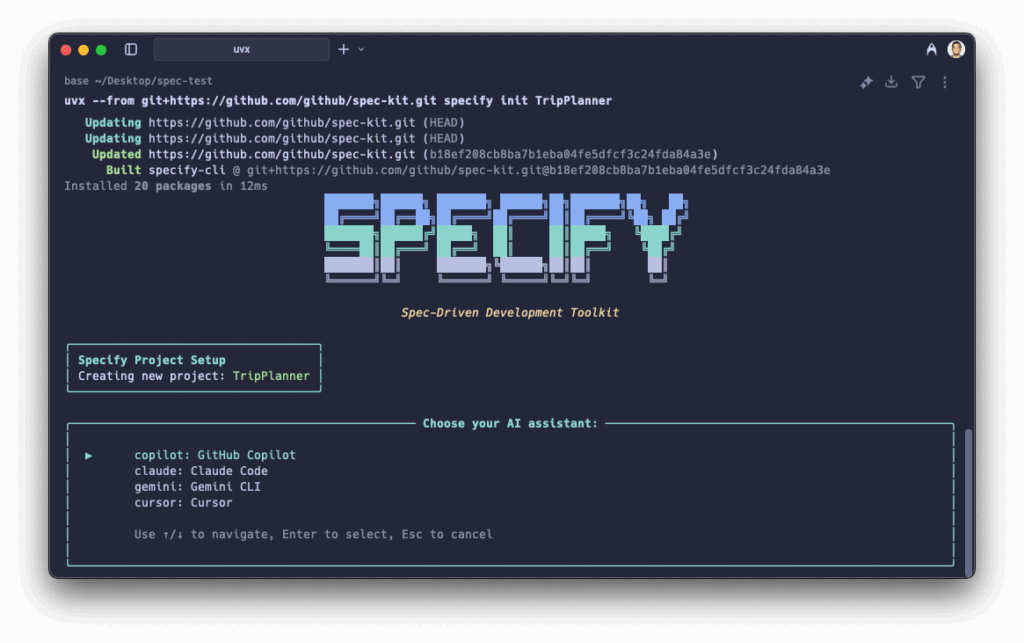
GitHub’s Spec Kit is a lightweight but effective toolkit for formalizing the “spec → plan → tasks → implementation” cycle. Instead of specs being dusty docs in a wiki, they live alongside your code in version control, versioned, reviewable, and tied to tasks and tests.
The Spec Kit encourages you to declare stacks, performance budgets, architectural rules, and constraints explicitly. This prevents AI tools (and humans) from guessing at hidden assumptions. Because it’s relatively flexible, teams can adopt it gradually, scaling the level of detail as project complexity grows. For most teams, starting small and iterating on the spec pays off quickly.
Claude Code Spec Workflow
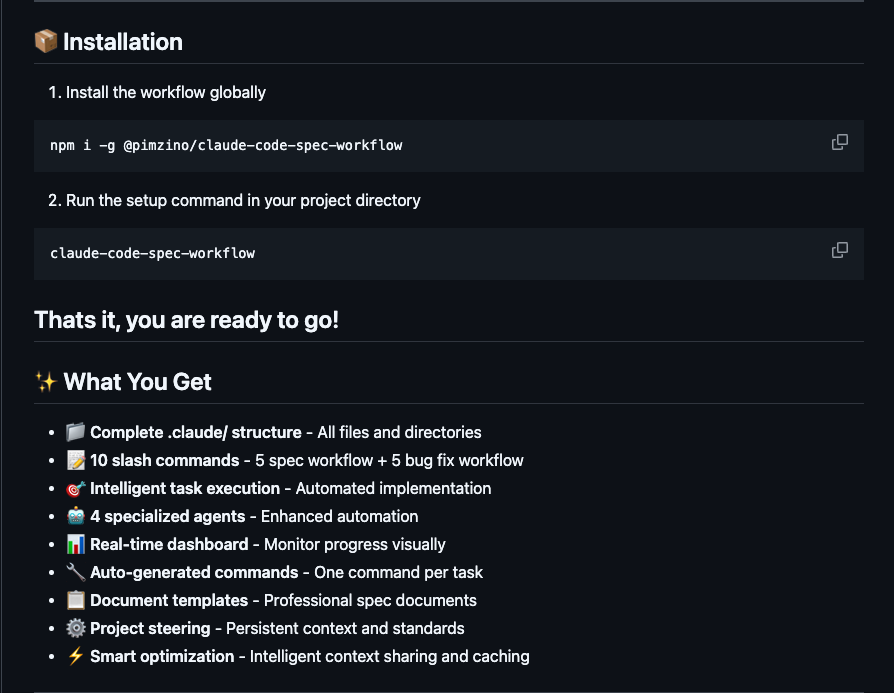
The Claude Code Spec Workflow is a structured way of working with Anthropic’s Claude Code environment. It provides a set of slash commands (like /spec-create, /spec-execute) that scaffold specs, generate technical plans, break down tasks, and even handle bug/fix workflows.
The goal is to turn specs into living artifacts: requirements flow into implementation tasks, and tasks connect back to tests and validation. This makes it easier to align AI agents with architecture and constraints instead of treating them as free-form assistants. Teams using Claude Code benefit from tighter feedback loops and clearer visibility into project progress. If your team already uses Claude, this workflow can reduce friction.
While each tool has its own style and integrations, the principle is the same: make specs first-class artifacts. Whether you use Kiro, GitHub Spec Kit, Claude Code Spec Workflow, or even a well-maintained markdown doc, the key is ensuring specs capture goals, constraints, and context so AI has solid ground to work from.
Bonus: MCPs (Model Context Protocols)
Spec-Driven Development is about giving AI agents the clarity they need. One way to push that even further is by using MCPs (Model Context Protocols), extensions that enrich an agent’s context with structured data from external sources. When paired with specs, MCPs help agents stay aligned with project goals and constraints instead of working in isolation.
Here are two examples worth exploring:
- Context7 by Upstash
This MCP feeds agents with up-to-date, version-specific documentation and code examples pulled straight from the source. Instead of relying on fuzzy memory or outdated snippets, the agent gets precise references inside the prompt, so the code it produces matches the exact framework versions and patterns your spec calls for. That reduces “it works on my machine” surprises. - Figma Context MCP
This connector brings design artifacts directly into the agent’s working context. Instead of pasting screenshots or manually translating design intent, the agent can access real component names, tokens, and layouts from Figma. When Agents have access to this kind of structured design data, it’s far better at accurate implementations than approaches that rely on screenshots or descriptions alone.
MCPs and specs solve complementary problems: specs define what should be built, MCPs supply the live context needed to build it correctly. Together, they reduce ambiguity, improve traceability, and let AI agents deliver code that better reflects both the design and the real-world environment. Specs set direction; MCPs supply facts.
Key Takeaways on Spec-Driven Development in the AI Era
1) Why should teams adopt SDD now?
Because AI speeds up coding but not alignment. Without specs, agents produce plausible but often brittle code that drifts from intent. Specs keep speed and reliability connected.
2) Is vibe-coding “good enough” for real projects?
Not beyond prototypes. Vibe-coding works for experiments or proofs of concept, but once stakes are higher, production code, multiple teams, performance/security constraints, it creates debt faster than value.
3) Aren’t detailed prompts basically specs?
No. Prompts are transient; specs are durable. Specs live in version control, can be reviewed, and evolve with the system. Prompts guide an interaction; specs guide a project.
4) Where does SDD add the most value?
- New projects, where foundations matter.
- Complex features that cut across systems.
- Long-lived codebases requiring future maintenance.
5) Where does SDD not make sense?
Small bug fixes, trivial tweaks, quick prototypes, or highly visual design work. In these cases, the overhead outweighs the benefits.
6) How do specs help AI agents specifically?
Specs give agents the context they lack: constraints, architecture, and non-functional requirements. This reduces rework, keeps outputs aligned, and allows multiple agents (or devs) to collaborate without drift.
7) What tools can help teams get started?
- Kiro: an agent-enabled IDE built around spec-driven workflows.
- GitHub Spec Kit: lightweight, repo-native specs tied to tasks and plans.
- Claude Code Spec Workflow: structured commands to turn specs into actionable workflows.
Ultimately, any well-maintained spec document works, as long as it’s treated as a first-class artifact.
8) What’s the bottom line?
Specs are becoming the connective tissue of AI-assisted development. They turn raw speed into sustainable progress, giving teams clarity, maintainability, and traceability. In the AI era, specs aren’t bureaucracy; they’re leverage.
Final Thoughts on Spec-Driven Development
AI is reshaping how software gets built. Features that once took weeks now appear in hours, and teams can move faster than ever before. But speed without direction has a cost: brittle systems, unclear ownership, and code that drifts from the original intent.
Spec-Driven Development is how you keep that from happening. By making specifications the anchor for design, implementation, testing, and maintenance, you ensure that what’s delivered reflects what was intended. It bridges the gap between product vision and technical execution, something AI alone can’t guarantee.
For AI agents, specs provide the guardrails they lack. With clear goals, constraints, and architectural rules, agents move from “guessing” to “building with purpose.” Instead of generating plausible but misaligned output, they contribute code that fits into the system, respects non-functional requirements, and scales with confidence.
The takeaway is simple: in the AI era, specs are no longer optional. They’re the difference between code that merely runs and software that lasts. By adopting spec-driven workflows now, teams set themselves up not just for faster delivery, but for reliability, maintainability, and alignment over the long haul.