
What is Hugging Face? The ML Platform For Building AI-Powered Apps


Natural Language Processing (NLP) is a key component in powering human-computer interactions. As consumers, we’re using and adopting more NLP-powered solutions everyday: from chatbots to voice search to translations, NLP is what powers computers to understand, interpret, and respond to human language. These tools have become so commonplace it can be easy to forget that building them is extremely complex. That’s where libraries like Hugging Face come in.
Table Of Contents
Hugging Face stands out as a transformative toolkit in the NLP ecosystem. In this article, we’ll dive into what sets Hugging Face apart, exploring its core features, the diverse tasks it supports, the vibrant community behind it, and a practical example showcasing its user-friendly interface. Ready to explore the capabilities of Hugging Face? Let’s get started!
What is Hugging Face 🤗?
Hugging Face is an open-source machine learning tool that was initially developed to focus on NLP tasks. The original vision for the product was a unique one, too: Hugging face was built as an “AI BFF” chatbot for teenagers, providing emotional support and entertainment.

Since its origins in 2016, Hugging face has expanded to include areas like computer vision, speech recognition, and even reinforcement learning (the process by which models are trained to make the most optimal decisions). Today, it’s a powerful platform where ML practitioners share and exchange their work (and has a valuation of $4.5 billion!) This collaborative environment facilitates the work of developers dealing with language data, making the development process simpler, faster, and more accessible for all.

It’s easiest to understand the power of Hugging Face with an example.
Example: Using Hugging Face in an E-Commerce Business
Let’s say you run an e-commerce business and want to analyze customer reviews to understand what people are saying about your product. With Hugging Face, you can use pre-trained models to quickly process and analyze all the text contained in your customer reviews, giving you valuable insights without having to write the model from scratch. These pre-trained models serve as ready-made solutions for a variety of NLP tasks, such as text classification, translation, and text generation.
But Hugging Face goes beyond offering models; it also provides a user-friendly interface for working with these models. Its intuitive tools and documentation make it easy to get started and build powerful language-based applications. Since Hugging Face is open-source, it’s constantly evolving and improving with contributions from a global community of developers. In essence, Hugging Face streamlines the NLP process, making it easier for developers to build powerful language-based applications without reinventing the wheel every time. It’s like having a toolbox full of specialized tools for working with language data.
Hugging Face Hub and Key Features
There are three key features Hugging Face offers that simplify the process of working with ML data: Datasets, Models, and Spaces. Each of them are hosted on the Hugging Face Hub as Git repositories. This centralized hub ensures easy access and seamless integration into your workflow, allowing you to focus on building innovative ML solutions without the hassle of managing multiple platforms.
The Hugging Face hub has become the Holy grail for data scientists and ML enthusiasts, attracting tech giants like Google, Microsoft, and Facebook, who share their models and datasets there. This collaborative platform enables researchers, developers, and enthusiasts to explore and experiment with a diverse range of ML models, accelerating innovation and knowledge sharing in the field. Let’s explore each feature in turn.
Let’s explore each of them in turn.

Hugging Face Datasets: Community-Curated Data for NLP Tasks
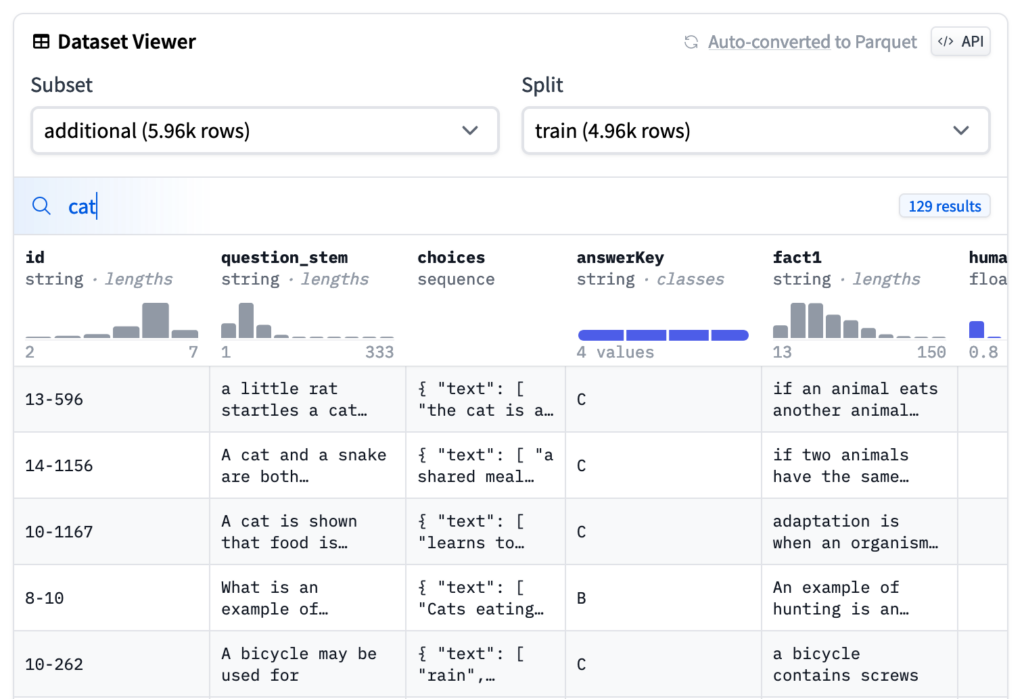
Datasets provide a vast collection of curated data for a variety of ML tasks, saving you valuable time and effort in data collection and preprocessing. Currently, there are more than 75,000 community-generated datasets with accompanying documentation and detailed information. Some datasets include a Dataset Viewer, which you can interact with and see the data. Whether you’re working on sentiment analysis, named entity recognition, or text summarization, you can easily find and access great datasets to help you in your projects.
Hugging Face Pre-Trained Models: Git Repositories for Machine Learning Tasks
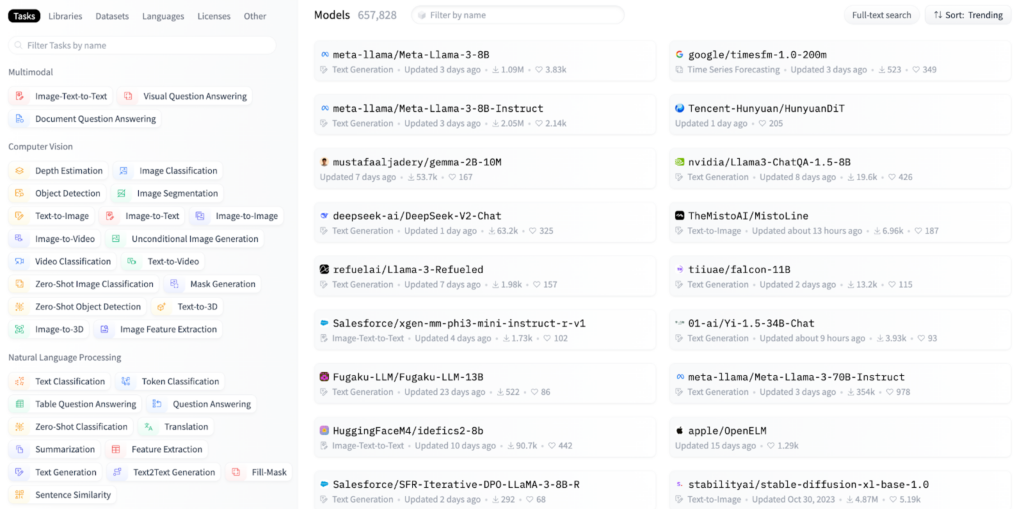
Models offers an extensive set of pre-trained models for many different ML applications. It supports dozens of libraries, including Transformers, which contains state-of-the-art pre-trained models like BERT and GPT. These models have been fine-tuned on large datasets to perform specific tasks with impressive accuracy. With just a few lines of code, you can tap into the power of these Transformers and achieve remarkable results in your projects. Instead of spending weeks or months training a model from scratch, you can leverage pre-trained models on Hugging Face and fine-tune them to suit your needs.
Pre-trained models can be used to perform many different tasks, like:
- Text: text classification, Q&A, summarization, text generation, sentiment analysis and translation in many different languages
- Image: image classification, image-to-text, image segmentation, and image detection
- Audio: audio classification, text-to-speech, and speech recognition.
You can see a more detailed view of all ML tasks they support on their website.
Hugging Face Spaces: ML-Powered Demo Apps
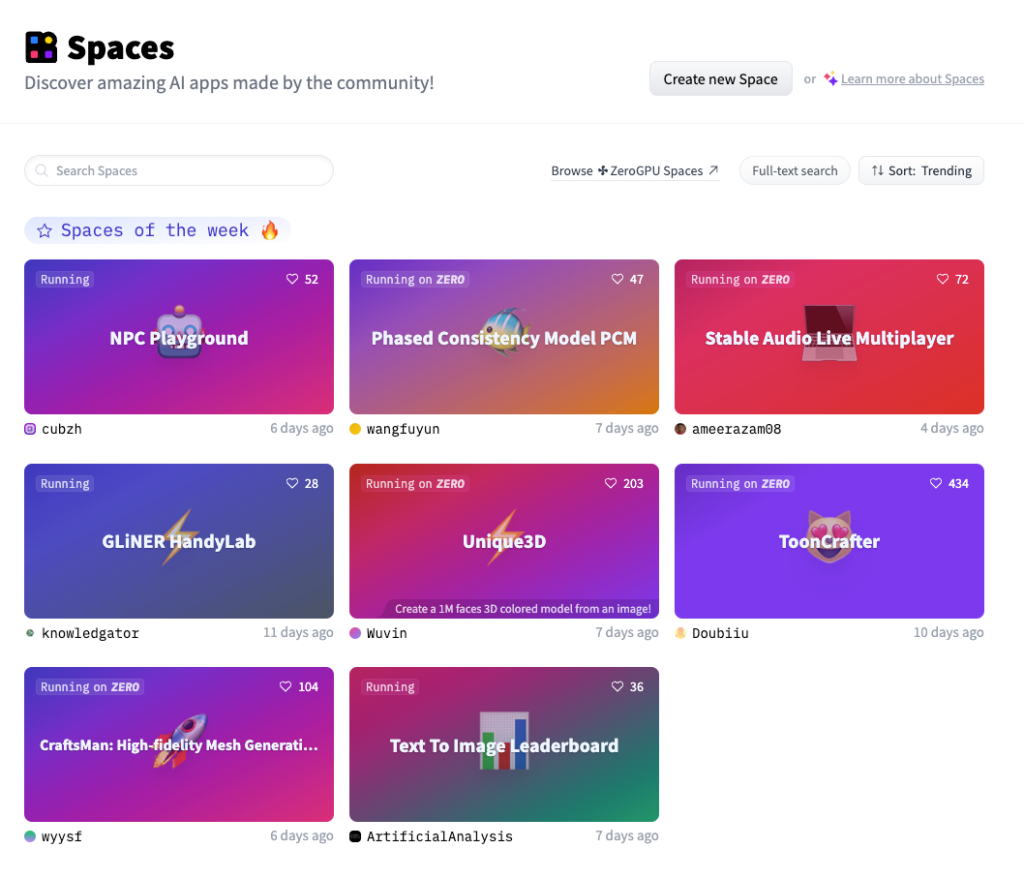
Finally, spaces is a collaborative feature that allows you to build, host, and share your ML apps within a single, organized workspace. With Spaces, you can host ML demo apps easily through two built-in Python frameworks: Streamlit and Gradio (though you can also create static Spaces using JavaScript and HTML). Currently, there are thousands of apps made by the community where you can explore amazing AI applications.
The Hugging Face hub has become the Holy grail for data scientists and ML enthusiasts, attracting tech giants like Google, Microsoft, and Facebook, who share their models and datasets there. This collaborative platform enables researchers, developers, and enthusiasts to explore and experiment with a diverse range of ML models, accelerating innovation and knowledge sharing in the field.
Community Support and Documentation
The Hugging Face community is much like the bedrock of the platform. The community has attracted developers, researchers, and AI enthusiasts who share their knowledge, experiences, and resources to support each other in their ML journeys.
Within the Hugging Face community, users can participate in forums and discussions to exchange ideas, seek advice, and showcase their projects. You can also join their Discord channel, which has tens of thousands of members that share knowledge and help each other. Whether you’re a beginner seeking guidance or an expert looking to contribute, the community welcomes everyone of all skill levels and backgrounds. Hugging Face also provides comprehensive support through its documentation, tutorials, and courses. Users can access guides, code examples, and step-by-step tutorials to help them get started with Hugging Face and master advanced NLP techniques. For instance, when exploring a specific task like Text Generation, you’ll find plenty of relevant information to assist and guide you in its proper usage. This includes concise explanations about the task itself, accompanied by videos, demos, and use cases. Additionally, it shows all models for that given task and their datasets available.

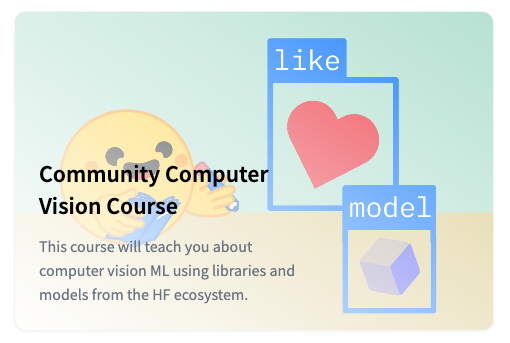
Moreover, when looking into a specific model, you’ll find all the necessary information to train, deploy, and get a better understanding of the model through Model Cards, which are files that provide handy information and examples of available apps that use the model you’re researching.And if that weren’t enough, Hugging Face has developed courses for each specialty, enabling everyone to get started and go from zero to hero with their libraries.
Real-World Example: Analyzing Customer Sentiment Using Python and Hugging Face Models
Returning to our e-commerce example, let’s say we want to analyze customer reviews and classify whether each one is positive, neutral, or negative. The first thing you need to do is install transformers by running this line on your terminal:
1pip install transformers
Once you’ve installed it, you can choose the task you want to work on and refer to its documentation for guidance. In this example, we’ll focus on sentiment analysis from a text classification task, as we want to analyze the customer review. So, let’s create a classifier using a pre-trained model:
1from transformers import pipeline23classifier = pipeline(4 task="sentiment-analysis",5 model="distilbert/distilbert-base-uncased-finetuned-sst-2-english"6)
Next, we’ll make an inference on a customer review:
1classifier("great for beginner or experienced person. Bought as a gift and she loves it.")
This will provide the following output:
1[{'label': 'POSITIVE', 'score': 0.9998518228530884}]
As you can see from this example, using a pre-trained model for sentiment analysis on a given sentence is remarkably simple. This serves as just a basic demonstration of the capabilities of this powerful tool, which can greatly assist you in your project and save you valuable time.
Get Started with Hugging Face in Your ML Project
To sum up, Hugging Face is a powerful platform for machine learning engineers. Its array of features, including Datasets, Models, and Spaces, streamline the process of working with ML data, making it more accessible and efficient. But the real powerhouse of Hugging Face is the collaborative environment that champions knowledge sharing and innovation, boasting an ecosystem with thousands of community-curated features and tools that enable developers to succeed. Through a simple practical example, we’ve demonstrated how easy it is to use Hugging Face for sentiment analysis, showcasing its power and simplicity.
As we move forward, I expect Hugging Face will have a growing impact on ML research and development. With continued contributions from the community and advancements in technology, we can expect even more exciting breakthroughs and applications in the near future. So, whether you are already an expert or just starting in this area who hasn’t discovered Hugging Face yet, now is the perfect time to explore it and unlock its potential in your ML projects.